 <
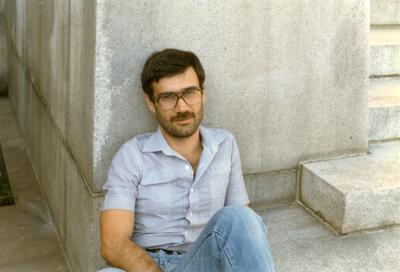
<In Berkeley in 1984.
3) How do you see the evolution of paraconsistent logic? What are the future challenges?
I do not see paraconsistency as any revolution, but as an adaptation of standard logic in the direction of general human reasoning. Standard logic is quite good for making mathematics, but not for common reasoning, including contemporary scientific reasoning and quantum phenonena, reasoning in Artificial Intelligence and in Machine Learning. We need a lightweight logic.
The relationship between paraconsistency and rationality is an essen- tial topic that should be studied in all its aspects. The Centre for Logic, Epistemology, and History of Science at Unicamp recently approved my proposal for the creation of a ‘Laboratory of Logic and Rationality’. The idea is to form a nucleus that central- izes the study of areas such as the relation between probabilistic systems, Markov processes and alternative logics, argumentation schemes, automatic and pragmatic reasoning (with applications to AI and Machine Learning), computability and logic, infor- mation and logic, economics and logic, and, not the least, philosophy.
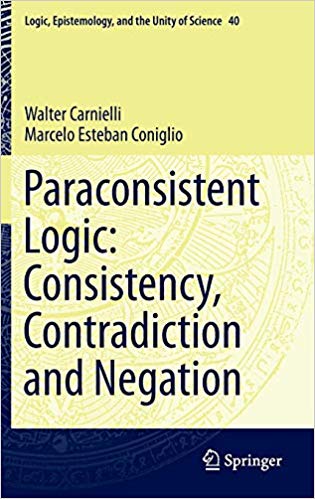
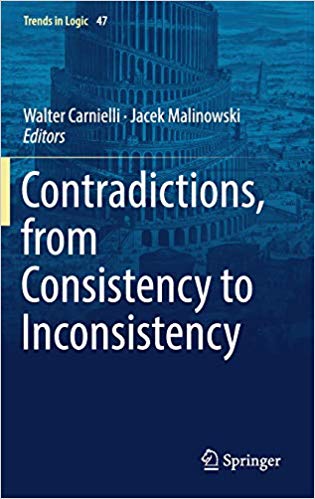
Recent work in collaboration with Abilio Rodrigues, Juliana Bueno-Soler and Marcelo Coniglio point to this direction. I was particularly delighted to have received the CAPES Prize for the best PhD dissertation in Philosophy for 2019, conferred to my student Bruno Mendonça and to myself, among hundreds of competitors. When a prize in Philosophy is given to a work in Logic those old times when some members of the philosophical comunity in Brazil doubted the "relevance of Logic for Philosphy" are happily behind.
The relationship between paraconsistency and rationality is an essen- tial topic that should be studied in all its aspects. The Centre for Logic, Epistemology, and History of Science at Unicamp recently approved my proposal for the creation of a ‘Laboratory of Logic and Rationality’. The idea is to form a nucleus that central- izes the study of areas such as the relation between probabilistic systems, Markov processes and alternative logics, argumentation schemes, automatic and pragmatic reasoning (with applications to AI and Machine Learning), computability and logic, infor- mation and logic, economics and logic, and, not the least, philosophy.
Recent work in collaboration with Abilio Rodrigues, Juliana Bueno-Soler and Marcelo Coniglio point to this direction. I was particularly delighted to have received the CAPES Prize for the best PhD dissertation in Philosophy for 2019, conferred to my student Bruno Mendonça and to myself, among hundreds of competitors. When a prize in Philosophy is given to a work in Logic those old times when some members of the philosophical comunity in Brazil doubted the "relevance of Logic for Philosphy" are happily behind.